What factor(s) led to Latin Americas debt crisis in the early 1980s?

The four common subregions in Latin America
The Latin American debt crisis (Spanish: Crunch de la deuda latinoamericana; Portuguese: Crise da dívida latino-americana) was a financial crunch that originated in the early 1980s (and for some countries starting in the 1970s), often known equally La Década Perdida (The Lost Decade), when Latin American countries reached a bespeak where their strange debt exceeded their earning power, and they were non able to repay it.
Origins [edit]

Mexico Rough oil prices from 1861 to 2011
In the 1960s and 1970s, many Latin American countries, notably Brazil, Argentina, and Mexico, borrowed huge sums of coin from international creditors for industrialization, especially infrastructure programs. These countries had soaring economies at the fourth dimension, and so the creditors were happy to provide loans. Initially, developing countries typically garnered loans through public routes like the World Depository financial institution. After 1973, private banks had an influx of funds from oil-rich countries which believed that sovereign debt was a rubber investment.[ane] Mexico borrowed against future oil revenues with the debt valued in US dollars, and then that when the toll of oil collapsed, so did the Mexican economy.
Betwixt 1975 and 1982, Latin American debt to commercial banks increased at a cumulative annual charge per unit of 20.4 pct. This heightened borrowing led Latin America to quadruple its external debt from United states$75 billion in 1975 to more than $315 billion in 1983, or fifty percent of the region'southward gross domestic product (GDP). Debt service (interest payments and the repayment of principal) grew even faster as global interest rates surged, reaching $66 billion in 1982, up from $12 billion in 1975.[two]
History [edit]
When the world economic system went into recession in the 1970s and 1980s, and oil prices skyrocketed, it created a breaking betoken for most countries in the region. Developing countries found themselves in a desperate liquidity crunch. Petroleum-exporting countries, affluent with greenbacks after the oil price increases of 1973–1980, invested their money with international banks, which "recycled" a major portion of the upper-case letter equally loans to Latin American governments. The sharp increment in oil prices caused many countries to search out more loans to cover the high prices, and fifty-fifty some oil-producing countries took on substantial debt for economic development, hoping that high prices would persist and let them to pay off their debt.[ane]
Equally interest rates increased in the United States of America and in Europe in 1979, debt payments also increased, making information technology harder for borrowing countries to pay back their debts.[iii] Deterioration in the exchange rate with the US dollar meant that Latin American governments ended upwards owing tremendous quantities of their national currencies, equally well every bit losing purchasing power.[4] The wrinkle of globe trade in 1981 acquired the prices of master resource (Latin America's largest consign) to autumn.[4]
While the unsafe aggregating of strange debt occurred over a number of years, the debt crisis began when the international capital letter markets became enlightened that Latin America would not be able to pay back its loans. This occurred in August 1982 when United mexican states's Finance Minister, Jesús Silva-Herzog, declared that Mexico would no longer be able to service its debt.[5] Mexico stated that it could not see its payment due-dates, and announced unilaterally a moratorium of 90 days; information technology also requested a renegotiation of payment periods and new loans in social club to fulfill its prior obligations.[4]
In the wake of Mexico's sovereign default, most commercial banks reduced significantly or halted new lending to Latin America. Equally much of Latin America's loans were short-term, a crisis ensued when their refinancing was refused. Billions of dollars of loans that previously would take been refinanced, were now due immediately.
The banks had to somehow restructure the debts to avoid financial panic; this usually involved new loans with very strict conditions, also equally the requirement that the debtor countries accept the intervention of the International Monetary Fund (International monetary fund).[four] There were several stages of strategies to slow and cease the crisis. The Imf moved to restructure the payments and reduce authorities spending in debtor countries. Later on it and the World Bank encouraged opened markets.[6] [7] Finally, the US and the Imf pushed for debt relief, recognizing that countries would not be able to pay back in full the large sums they owed.[viii]
Withal, some unorthodox economists like Stephen Kanitz aspect the debt crunch not to the loftier level of indebtedness nor to the disorganization of the continent'southward economy. They say that the crusade of the crisis was leverage limits such as US government banking regulations which forbid its banks from lending over ten times the amount of their capital, a regulation that, when the inflation eroded their lending limits, forced them to cut the admission of underdeveloped countries to international savings.[nine]
Effects [edit]
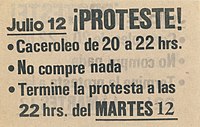
The debt crisis of 1982 was the well-nigh serious of Latin America's history. Incomes and imports dropped; economic growth stagnated; unemployment rose to loftier levels; and aggrandizement reduced the buying power of the middle classes.[4] In fact, in the ten years after 1980, real wages in urban areas actually dropped betwixt 20 and 40 percent.[vi] Additionally, investment that might have been used to address social issues and poverty was instead being used to pay the debt.[i] Losses to bankers in the United States were catastrophic, perchance more than the banking manufacture's entire collective profits since the nation'south founding in the tardily 1700s.[ten]
In response to the crisis, virtually nations abandoned their import substitution industrialization (ISI) models of economy and adopted an export-oriented industrialization strategy, commonly the neoliberal strategy encouraged by the IMF, although in that location were exceptions such as Chile and Costa rica, which adopted reformist strategies. A massive process of capital letter outflow, specially to the U.s., served to depreciate the exchange rates, thereby raising the real interest rate. Existent GDP growth charge per unit for the region was only 2.3 percent between 1980 and 1985, merely in per capita terms Latin America experienced negative growth of almost ix percent. Betwixt 1982 and 1985, Latin America paid back US$108 billion.[4]
International Monetary Fund [edit]
Earlier the crisis, Latin American countries such as Brazil and Mexico borrowed coin to enhance economic stability and reduce the poverty rate. Still, as their inability to pay back their foreign debts became apparent, loans ceased, stopping the menstruum of resources previously available for the innovations and improvements of the previous few years. This rendered several one-half-finished projects useless, contributing to infrastructure bug in the afflicted countries.[11]
During the international recession of the 1970s, many major countries attempted to slow down and cease inflation in their countries by raising the involvement rates of the money that they loaned, causing Latin America's already enormous debt to increase further. Betwixt the years of 1970 to 1980, Latin America'south debt levels increased by more than one-thou percent.[xi]
The crunch acquired the per capita income to drop and besides increased poverty equally the gap between the wealthy and poor increased dramatically. Due to the plummeting employment rate, children and young adults were forced into the drug trade, prostitution and terrorism.[12] The low employment rate likewise worsened many problems like homicides and crime and fabricated the afflicted countries undesirable places to live. Frantically trying to solve these issues, debtor countries felt pressured to constantly pay back the coin that they owed, which made it hard to rebuild an economy already in ruins.
Latin American countries, unable to pay their debts, turned to the International monetary fund (International Monetary Fund), which provided money for loans and unpaid debts. In return, the International monetary fund forced Latin America to make reforms that would favor complimentary-market capitalism, further aggravating inequalities and poverty weather condition.[13] [ failed verification ] The International monetary fund also forced Latin America to implement austerity plans and programs that lowered total spending in an effort to recover from the debt crunch. This reduction in government spending farther deteriorated social fractures in the economy and halted industrialisation efforts. The efforts of the International monetary fund finer aimed to transform Latin America's economy abruptly into a capitalist gratis-trade type of economic system, which is an economic model preferred by wealthy and fully adult countries.[14]
Latin America'due south growth rate fell dramatically due to government austerity plans that restricted further spending. Living standards too fell aslope the growth charge per unit, which caused intense anger from the people towards the IMF, a symbol of "outsider" ability over Latin America.[14] Regime leaders and officials were ridiculed and some even discharged due to interest and defending of the International monetary fund. In the late 1980s, Brazilian officials planned a debt negotiation meeting where they decided to "never again sign agreements with the IMF".[xv] The result of IMF intervention caused greater financial deepening (Financialization) and dependence on the developed globe majuscule flows, as well as increased exposure to international volatility.[16] The application of structural adjustment programs entailed high social costs in terms of ascent unemployment and underemployment, falling existent wages and incomes, and increased poverty.
2015 levels of external debt [edit]
The following is a list of external debt for Latin America based on a 2015 written report by The World Factbook.[17] [ relevance questioned ]
| Rank | Country – Entity | External Debt (million Us$) | Appointment of data |
|---|---|---|---|
| 24 | Brazil | 535,400 | 31 Dec 2014 est. |
| 26 | United mexican states | 438,400 | 31 December 2014 est |
| 42 | Republic of chile | 140,000 | 31 Dec 2014 est. |
| 45 | Argentina | 115,700 | 31 Dec 2014 est. |
| 51 | Republic of colombia | 84,000 | 31 December 2014 est. |
| 52 | Venezuela | 69,660 | 31 Dec 2014 est. |
| 60 | Peru | 56,470 | 31 December 2014 est. |
| 79 | Republic of cuba | 25,230 | 31 Dec 2014 est. |
| 83 | Ecuador | 21,740 | 31 Dec 2014 est. |
| 84 | Dominican Republic | 19,720 | 31 Dec 2014 est. |
| 86 | Costa rica | eighteen,370 | 31 Dec 2014 est. |
| 88 | Uruguay | 17,540 | 31 Dec 2014 est. |
| 93 | Guatemala | 15,940 | 31 December 2014 est. |
| 94 | Panama | 15,470 | 31 Dec 2014 est. |
| 95 | El Salvador | xv,460 | 31 December 2014 est. |
| 103 | Nicaragua | 10,250 | 31 Dec 2014 est. |
| 106 | Paraguay | 8,759 | 31 Dec 2014 est. |
| 108 | Republic of bolivia | viii,073 | 31 Dec 2014 est. |
| 117 | Republic of honduras | vii,111 | 31 Dec 2014 est. |
Encounter also [edit]
- Chilean crisis of 1982
- 1998–2002 Argentine great depression
- Latin American economy
- Listing of sovereign debt crises
- Odious debt
References [edit]
- ^ a b c Ferraro, Vincent (1994). World Security: Challenges for a New Century. New York: St. Martin's Printing.
- ^ Institute of Latin American Studies, The Debt Crunch in Latin America, p. 69
- ^ Schaeffer, Robert. Understanding Globalization, p. 96
- ^ a b c d e f García Bernal, Manuela Cristina (1991). "Iberoamérica: Evolución de una Economía Dependiente". In Luís Navarro García (Coord.), Historia de las Américas, vol. Four, pp. 565–619. Madrid/Sevilla: Alhambra Longman/Universidad de Sevilla. ISBN 978-84-205-2155-viii
- ^ Pastor, Robert A. Latin American Debt Crisis: Adjusting for the Past or Planning for the Hereafter, p. 9
- ^ a b Felix, David (Fall 1990). "Latin America'south Debt Crisis". World Policy Periodical. 7 (four): 733–71.
- ^ Devlin, Robert; Ricardo French-Davis (July–September 1995). "The great Latin American debt crisis: a decade of asymmetric adjustment". Revista de Economía Política. fifteen (3).
- ^ Krugman, Paul (2007). International Economics: Theory and Policy. Pearson Educational activity.
- ^ Kanitz, Stephen. "Brazil: The Emerging Boom 1993–2005 Chapter two". brazil.melhores.com.br. Archived from the original on 5 August 2017. Retrieved 22 February 2009.
- ^ Nassim Nicholas Taleb (2007). The Black Swan: The Impact of the Highly Improbable. Random Business firm.
- ^ a b "Encyclopædia Britannica Online School Edition". Encyclopædia Britannica . Retrieved 21 May 2012.
- ^ Ruggiero, Gregory. "Latin American Debt Crunch: What Were Its Causes And Is It Over?". AngelFire. Retrieved fifteen May 2012.
- ^ Ghosh, Jayati. The Economic and Social Effects of Fiscal Liberalization: A Primer for Developing Countries. Working Paper. United Nations, Department of Economics and Social Affairs, 2005.
- ^ a b "Latin American debt crisis". ABC-CLIO. Retrieved 22 May 2012.
- ^ Pastor, Manuel Jr. (1989). "Latin America, the Debt Crisis, and the International Monetary Fund". Latin American Perspectives. JSTOR. sixteen (1): 79–110. doi:10.1177/0094582X8901600105. JSTOR 2633823. S2CID 144458701.
- ^ Palma, Gabriel. The 3 Routes to Fiscal Crises: The Need for Capital Controls. SCEPA Working Newspaper. Schwartz Center for Economic Policy Analysis (SCEPA), The New School, 2000.
- ^ The World Factbook, 2015
Further reading [edit]
- Signoriello, Vincent J. (1991), Commercial Loan Practices and Operations, Affiliate 8 Servicing Foreign Debt, Latin American Debt Crisis, Performing a Vital Service, ISBN 978-one-55520-134-0.
- Signoriello, Vincent J. (1985, Jan–Feb) International Correspondent Banker Magazine, London, England, Performing a Vital Service, The Future for Debt Rescheduling, pp. 44–45.
- Sunkel, Osvald and Stephany Griffith-Jones (1986), Debt and Development Crises in Latin America: The Finish of an Illusion, Oxford University Printing.
- Pastor, Manuel (1993). "15: Managing the Latin American Debt Crisis: The International monetary fund and Beyond". In Gerald A. Epstein; Julie Graham; Jessica Gordon Nembhard (eds.). Creating a new world economy: forces of change & plans for activity. Temple University Press. ISBN978-1-56639-054-v.
External links [edit]
- Latin American Debt Crunch: Effects on Mexico from the Dean Peter Krogh Foreign Affairs Digital Archives
- International Budgetary Fund
Source: https://en.wikipedia.org/wiki/Latin_American_debt_crisis
0 Response to "What factor(s) led to Latin Americas debt crisis in the early 1980s?"
Post a Comment